
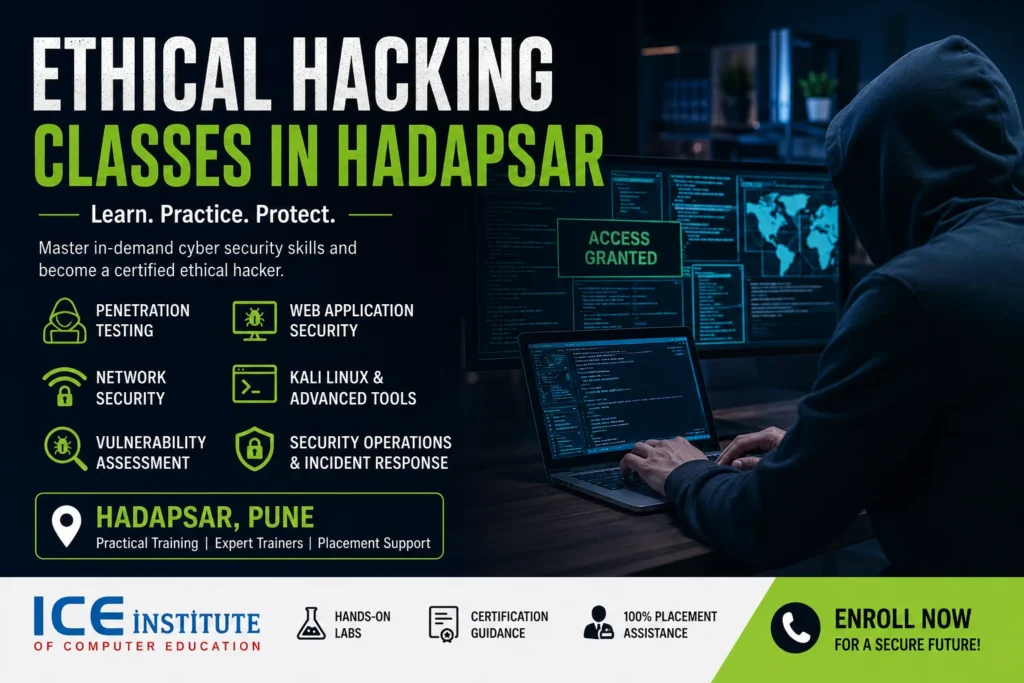
Cybercrime is growing at an unprecedented pace, affecting businesses, governments, healthcare organizations, banks, educational institutions, and even individuals. As organizations invest more in digital transformation, they also need skilled professionals who can identify security weaknesses before cybercriminals exploit them. This increasing demand has made Ethical Hacking one of the fastest-growing career fields in the IT industry.
If you are searching for Ethical Hacking Classes in Hadapsar, you are already moving in the right direction. Hadapsar has become one of Pune’s fastest-growing IT and business hubs, home to thousands of software professionals and technology companies. Whether you are a college student, recent graduate, working professional, or someone planning to switch careers, learning ethical hacking can open doors to exciting opportunities in cyber security.
In this comprehensive guide, we’ll explain everything you need to know about ethical hacking training, career opportunities, required skills, certifications, salary expectations, and how to choose the right training institute. You’ll also discover why many students from Hadapsar choose to travel a short distance for advanced practical cyber security training with ICE Institute in Pune.
Students looking for comprehensive practical training can explore our Ethical Hacking Course in Pune, where we cover networking, penetration testing, web application security, digital forensics, cloud security, and more.
Why is Hadapsar Becoming a Hub for Cyber Security Education?
Over the last decade, Hadapsar has transformed into one of Pune’s busiest commercial and IT locations. Areas such as Magarpatta City, Amanora Park Town, SP Infocity, and nearby business parks have attracted multinational corporations, software development companies, startups, and financial organizations.
As businesses continue moving their operations online, cyber threats have become more sophisticated. Organizations require trained cyber security professionals to protect sensitive customer information, financial transactions, cloud infrastructure, and business applications.
Because of this growing demand, many students and IT professionals living in Hadapsar are actively looking for quality cyber security and ethical hacking courses that focus on practical learning rather than only theoretical concepts.
Some of the key reasons students in Hadapsar are choosing ethical hacking as a career include:
- High demand for cyber security professionals
- Excellent salary packages for skilled candidates
- Opportunities to work with multinational companies
- Remote and hybrid job opportunities
- International certification pathways
- Continuous learning and career growth
- Exciting hands-on work involving real-world security testing
What is Ethical Hacking?
Ethical hacking is the process of legally testing computer systems, networks, web applications, and cloud infrastructure to identify security vulnerabilities before malicious hackers can exploit them.
Unlike cybercriminals, ethical hackers work with permission from organizations to strengthen their security posture. Their primary objective is to discover weaknesses and recommend solutions before an actual attack occurs.
Ethical hackers simulate real cyber attacks in a controlled environment to evaluate the effectiveness of an organization’s security controls. This proactive approach helps companies protect confidential data, prevent financial losses, and maintain customer trust.
Ethical hackers commonly perform activities such as:
- Network vulnerability assessments
- Web application security testing
- Wireless network assessments
- Password security analysis
- Social engineering simulations
- Cloud security reviews
- Mobile application security testing
- Active Directory security assessments
- Incident response support
- Security compliance testing
Difference Between Ethical Hackers and Malicious Hackers
Many beginners believe hacking always refers to illegal activities. However, there are different types of hackers based on their intentions.
White Hat Hackers
White Hat Hackers, also known as Ethical Hackers, work legally with proper authorization. They help organizations identify and fix security vulnerabilities before attackers exploit them.
Their responsibilities include:
- Conducting penetration testing
- Assessing application security
- Performing vulnerability assessments
- Writing detailed security reports
- Recommending remediation strategies
This is the career path you will prepare for through professional ethical hacking training.
Black Hat Hackers
Black Hat Hackers exploit vulnerabilities without permission for financial gain, data theft, or disruption of services. Their activities are illegal and punishable under cybercrime laws.
Grey Hat Hackers
Grey Hat Hackers operate somewhere between White Hat and Black Hat hackers. They may discover vulnerabilities without authorization but generally disclose them rather than exploiting them for personal gain. However, accessing systems without permission is still considered unauthorized and can have legal consequences.
For more details on Types of Hacker you can read our blog
Why Learn Ethical Hacking in Hadapsar?
Hadapsar is surrounded by several prominent IT parks and business districts that employ thousands of technology professionals. This ecosystem has created a strong demand for cyber security expertise across industries.
Professionals trained in ethical hacking can work in sectors such as:
- Information Technology
- Banking and Financial Services
- Healthcare
- Manufacturing
- Government Organizations
- Cloud Service Providers
- E-Commerce Companies
- Software Development Firms
- Cyber Security Consulting Companies
- Telecommunications
As organizations increasingly adopt cloud computing, artificial intelligence, and Internet of Things (IoT) technologies, securing digital infrastructure has become a top priority.
This has significantly increased the demand for professionals skilled in penetration testing, vulnerability assessment, cloud security, digital forensics, and security operations.
Who Should Join an Ethical Hacking Course?
One of the biggest advantages of ethical hacking is that it welcomes learners from diverse educational backgrounds. While having an IT background can be helpful, many successful cyber security professionals begin with little or no prior technical experience.
This course is suitable for:
College Students
Students pursuing BCA, BSc Computer Science, B.Tech, BE, MCA, MSc IT, Diploma in Computer Engineering, or related fields can gain practical skills that improve employability before graduation.
Working Professionals
Software developers, network administrators, system engineers, technical support executives, cloud engineers, and DevOps professionals can enhance their career prospects by developing cyber security expertise.
Career Changers
Professionals from non-IT backgrounds who are willing to learn networking, operating systems, and cyber security fundamentals can transition into entry-level cyber security roles with the right training and dedication.
Entrepreneurs and Business Owners
Understanding cyber security helps business owners protect sensitive customer data, prevent ransomware attacks, secure online transactions, and strengthen overall business resilience.
Essential Skills You Will Learn During Ethical Hacking Training
A professional ethical hacking program goes beyond simply teaching hacking tools. It develops a strong foundation in networking, operating systems, programming, security concepts, and penetration testing methodologies.
Some of the core skills include:
| Skill Area | What You Will Learn |
|---|---|
| Networking | TCP/IP, OSI Model, Routing, Switching |
| Linux Administration | Kali Linux, Ubuntu, Command Line |
| Windows Security | Active Directory, User Management |
| Web Technologies | HTTP, HTTPS, HTML, JavaScript Basics |
| Programming | Python Basics for Security Automation |
| Vulnerability Assessment | Identifying Security Weaknesses |
| Penetration Testing | Simulating Real-World Attacks |
| Wireless Security | Wi-Fi Security Testing |
| Password Security | Password Auditing Techniques |
| Security Reporting | Professional Vulnerability Reports |
Learning these foundational skills prepares students for advanced topics such as exploit development, web application security testing, cloud security, malware analysis, and digital forensics.
Why Practical Training Matters More Than Theory
Cyber security is a practical field. Reading books or watching videos alone is not enough to become a skilled ethical hacker.
The best institutes focus on hands-on learning through dedicated labs where students practice in a safe and legal environment.
Practical training typically includes:
- Network scanning using Nmap
- Packet analysis with Wireshark
- Web application testing using Burp Suite
- Vulnerability scanning with Nessus
- Exploitation using Metasploit Framework
- Linux privilege escalation exercises
- Windows Active Directory labs
- SQL Injection demonstrations
- Cross-Site Scripting (XSS) labs
- Password auditing using Hashcat and John the Ripper
Working on realistic lab environments helps students build confidence and prepares them for real-world cyber security roles.
If you’re interested in a broader learning path, our Cyber Security Course in Pune includes ethical hacking, SOC operations, cloud security, and digital forensics.
Complete Course Modules Covered in Ethical Hacking Classes
A professional ethical hacking course should provide much more than an introduction to hacking tools. The curriculum should build a strong foundation in networking, operating systems, security concepts, penetration testing methodologies, and industry best practices. At ICE Institute, the training is designed to help students gain practical experience through hands-on labs and real-world scenarios.
Some of the major modules included in a comprehensive ethical hacking program are:
1. Networking Fundamentals
Every ethical hacker must understand how networks communicate. This module covers:
- OSI & TCP/IP Models
- IP Addressing and Subnetting
- DNS, DHCP, FTP, SMTP
- Routing & Switching
- Firewalls and Network Security
- VPN Technologies
A solid understanding of networking makes it easier to identify vulnerabilities during penetration testing.
2. Linux Fundamentals
Most security professionals use Linux-based operating systems, especially Kali Linux.
Students learn:
- Linux File System
- Terminal Commands
- File Permissions
- User Management
- Bash Scripting
- Process Management
- Package Installation
Learning Linux is essential because many security tools run on this platform.
3. Footprinting & Reconnaissance
Reconnaissance is the first phase of ethical hacking, where information about a target is collected legally.
Topics include:
- Open Source Intelligence (OSINT)
- WHOIS Lookup
- Google Dorking
- DNS Enumeration
- Email Enumeration
- Website Footprinting
- Social Media Intelligence
Students understand how attackers gather information before launching an attack and how organizations can reduce unnecessary exposure.
4. Network Scanning & Enumeration
This module teaches students how to identify live systems, open ports, running services, and potential vulnerabilities.
Students perform:
- Port Scanning
- Host Discovery
- Service Detection
- Banner Grabbing
- SMB Enumeration
- SNMP Enumeration
- LDAP Enumeration
These techniques help security professionals understand the attack surface of a network.
5. Vulnerability Assessment
Before exploiting a vulnerability, it must first be identified.
Students learn:
- CVE Database
- CVSS Scoring
- Risk Assessment
- Vulnerability Prioritization
- Patch Management
- Reporting
Understanding vulnerabilities helps organizations reduce security risks before attackers exploit them.
6. System Hacking
This module introduces common attack techniques in a controlled lab environment.
Topics include:
- Password Security
- Authentication Mechanisms
- Windows Security
- Linux Security
- Privilege Escalation Concepts
- Credential Protection
- Security Hardening
All demonstrations are performed in authorized practice environments for educational purposes.
7. Web Application Security
Modern businesses rely heavily on web applications, making them a common target for attackers.
Students learn about:
- OWASP Top 10
- SQL Injection
- Cross-Site Scripting (XSS)
- Broken Authentication
- Security Misconfiguration
- File Upload Vulnerabilities
- Session Management
- Secure Coding Practices
8. Wireless Network Security
Topics include:
- Wi-Fi Security Standards
- WPA2/WPA3
- Wireless Threats
- Rogue Access Points
- Wireless Monitoring
- Wireless Security Best Practices
9. Cloud Security Basics
Cloud platforms are widely adopted by businesses.
Students learn:
- AWS Security Basics
- Identity & Access Management
- Cloud Misconfigurations
- Secure Storage
- Logging & Monitoring
- Shared Responsibility Model
10. Security Operations (SOC)
Security Operations Centers monitor organizations 24×7.
Students gain exposure to:
- Security Monitoring
- SIEM Concepts
- Log Analysis
- Threat Detection
- Incident Response
- Security Alerts
Popular Cyber Security Tools You Will Master
Practical exposure to industry-standard tools is essential for becoming an ethical hacker. During the course, students work with professional tools used by cyber security experts worldwide.
| Tool | Purpose |
|---|---|
| Kali Linux | Penetration Testing Operating System |
| Nmap | Network Discovery & Port Scanning |
| Wireshark | Packet Analysis & Network Troubleshooting |
| Burp Suite | Web Application Security Testing |
| Metasploit Framework | Penetration Testing Framework |
| Nessus | Vulnerability Assessment |
| OpenVAS | Open Source Vulnerability Scanner |
| Splunk | Security Information & Event Management (SIEM) |
| OWASP ZAP | Web Application Security Testing |
| Nikto | Web Server Security Scanner |
| Hydra | Password Security Testing |
| John the Ripper | Password Hash Auditing |
| Gobuster | Directory & DNS Enumeration |
| SQLMap | SQL Injection Testing (Authorized Environments Only) |
Working with these tools in dedicated lab environments helps students understand how security assessments are performed professionally.
Career Opportunities After Ethical Hacking Training
Cyber security is one of the fastest-growing career domains worldwide. Organizations across finance, healthcare, IT services, manufacturing, retail, and government sectors require skilled professionals to protect their digital infrastructure.
After completing an ethical hacking course, students can explore various career paths, including:
- SOC Analyst
- Cyber Security Analyst
- Penetration Tester
- Vulnerability Assessment Engineer
- Security Consultant
- Incident Response Analyst
- Network Security Engineer
- Web Application Security Tester
- Cloud Security Associate
- Information Security Analyst
With additional certifications and experience, professionals can advance into leadership roles such as Security Architect, Threat Hunter, Security Manager, or Cyber Security Consultant.
Average Salary After Learning Ethical Hacking
The cyber security industry offers attractive salary packages based on skills, certifications, and experience.
| Job Role | Average Annual Salary (India) |
|---|---|
| SOC Analyst | ₹3 – ₹6 LPA |
| Security Analyst | ₹4 – ₹8 LPA |
| Penetration Tester | ₹5 – ₹10 LPA |
| VAPT Engineer | ₹5 – ₹12 LPA |
| Cyber Security Consultant | ₹8 – ₹18 LPA |
| Cloud Security Engineer | ₹8 – ₹20 LPA |
Note: Salaries vary depending on location, employer, certifications, experience, and technical expertise.
Why Students from Hadapsar Choose ICE Institute
While there are several training providers across Pune, many students from Hadapsar prefer ICE Institute because of its focus on practical learning and career-oriented training.
Some of the advantages include:
Practical Cyber Security Labs
Students perform hands-on exercises instead of relying only on classroom theory. Practical labs help reinforce concepts and improve confidence.
Industry-Oriented Curriculum
The syllabus is regularly updated to include current cyber security trends, tools, and best practices relevant to today’s industry.
Experienced Trainers
Training is delivered by professionals with real-world experience in ethical hacking, penetration testing, vulnerability assessment, and cyber security operations.
Small Batch Size
Smaller batches provide better interaction with instructors, allowing students to ask questions and receive individual guidance during practical sessions.
Placement Assistance
Students receive support with resume preparation, interview guidance, mock interviews, and career counseling to help them pursue opportunities in the cyber security field.
Flexible Learning Options
Weekend and weekday batches make it convenient for both students and working professionals to attend classes.
ICE Institute vs Typical Ethical Hacking Training
Choosing the right institute can significantly impact your learning experience. The table below highlights some of the factors students should evaluate before enrolling.
| Feature | ICE Institute | Typical Training Institute |
|---|---|---|
| Practical Labs | ✔ Extensive hands-on practice | Limited lab exposure |
| Live Attack Simulations | ✔ Available in controlled environments | Rare |
| Small Batch Size | ✔ Yes | Often large batches |
| Industry-Focused Curriculum | ✔ Regularly updated | May vary |
| Career Guidance | ✔ Resume & interview support | Limited |
| Placement Assistance | ✔ Available | Depends on institute |
| Flexible Batch Timings | ✔ Weekday & Weekend | Varies |
| Instructor Support | ✔ Personalized guidance | Limited interaction |
When comparing institutes, students should look beyond marketing claims and evaluate the quality of practical training, instructor expertise, and career support.
Continue Your Cyber Security Journey
If you’re searching for Ethical Hacking Classes in Hadapsar, it’s important to choose a program that emphasizes practical learning, industry-relevant skills, and long-term career development. A well-structured course combined with consistent practice can help you build the expertise needed for roles in penetration testing, vulnerability assessment, and cyber security operations.
To explore the complete curriculum, certification roadmap, and training details, visit our Ethical Hacking Course in Pune page. There you’ll find information about course modules, lab facilities, batch schedules, and how the program prepares students for a career in cyber security.
You can also explore our Cyber Security Course, CEH Training, and other learning resources to understand which program best matches your career goals.